How hard is Toubkal? The answer in hours and metres
How hard is Toubkal? Hard enough that plenty of people who attempt it do not summit on a first try. Gentle enough that you will never once need your hands. Adjectives are useless here, so I will give you the answer in hours and metres — three days, 29 kilometres on foot, 2,427 metres of ascent, and one morning that starts at 04:30 in the dark.
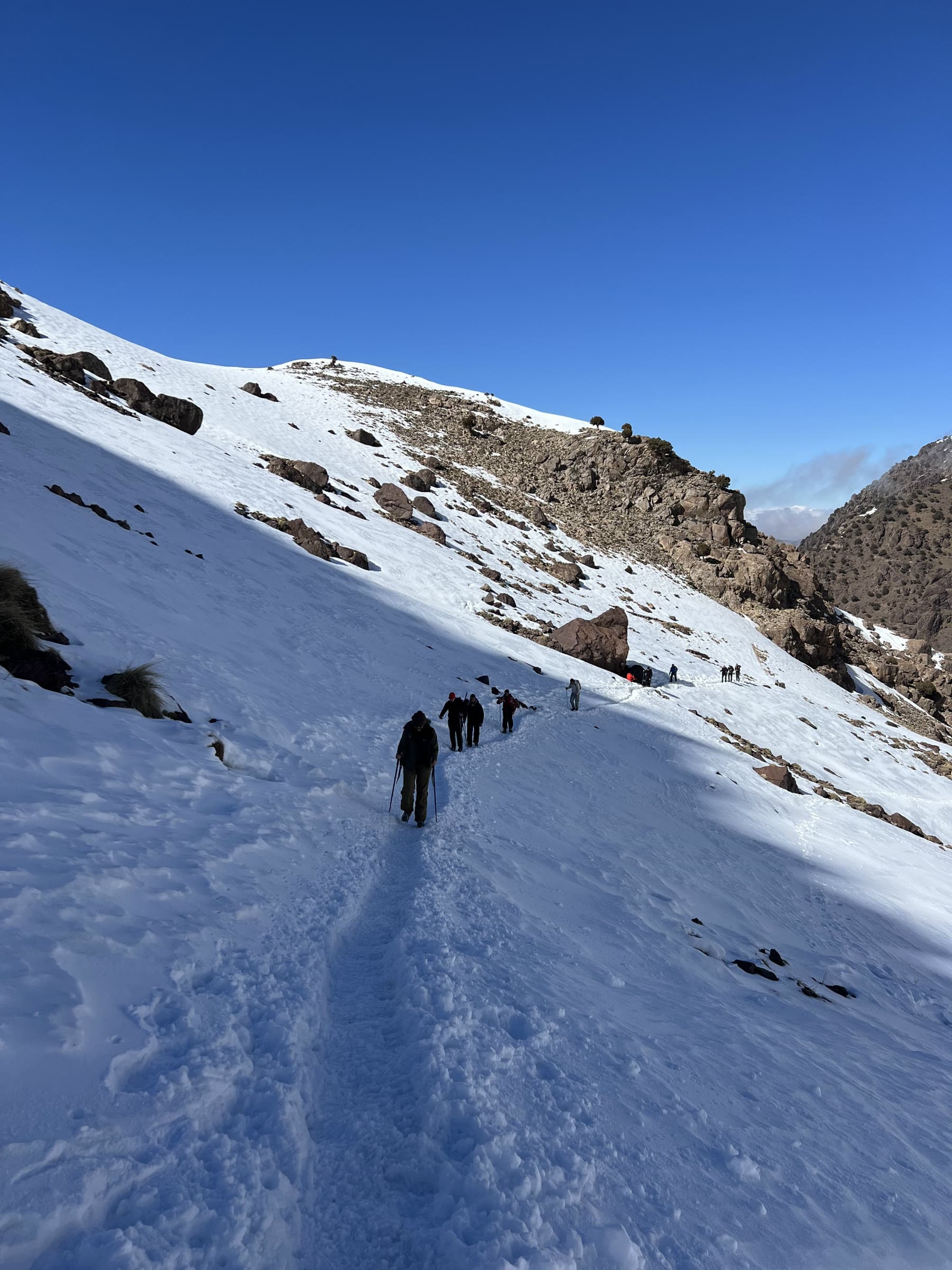
SOUTH CWM 3,650 M
WHAT IT IS NOT · NO ROPES, NO HANDS
Start with what you will not be doing, because that is the part people get wrong before they even ask. There is no rope on the standard route up Toubkal. No harness, no belay, no exposed scrambling where your hands come off your poles to keep you on the mountain. It is a walk — a long, steep, high walk on bad ground, but a walk — and you need no prior mountaineering experience and no hiking CV to be on it. Then the numbers. Three days. Twenty-nine kilometres on foot, round trip. Two thousand four hundred and twenty-seven metres of ascent. A summit at 4,167 metres, which is the highest ground in North Africa. Spread evenly over three days that would be a pleasant week's walking. It is not spread evenly. One day carries almost none of it, one carries most of the climbing, and one carries the early start and the thin air — and once you can see how the load is distributed you will judge your own chances far better than any single difficulty rating lets you. One honest exception to all of the above: from roughly December to March the ground above the refuge is snow, and then the top section is a snow climb rather than a walk. Crampons and an axe, which we carry for you in season and teach at the refuge the evening before you use them.
FRIDAY · 45 MINUTES AND 160 METRES
The trip starts in Marrakech at 450 metres on a Friday afternoon. Two hours in a vehicle to the head of the Aït Mizane valley, then 45 minutes on foot and 160 metres of climbing to Aremd, at 1,900 metres. That is the whole day's effort. Forty-five minutes. If you can carry a daypack up a village path for three quarters of an hour, Friday will not trouble you. The evening does the real work: kit check, dinner in a family gite, and a briefing that goes through Saturday and Sunday hour by hour so that nobody is guessing. Then you sleep at 1,900 metres, which is the single most useful thing that happens all weekend. Your body starts adjusting a full day before it has to climb. A schedule that skips this night and runs straight from Marrakech to the refuge on the Saturday is asking your body to do that adjusting while it is also working.
SATURDAY · 10 KM, +1,307 M, ABOUT SIX HOURS
Saturday is the long grind, and for most people it is the hardest day of the three — not the summit day. Ten kilometres on foot, 1,307 metres of ascent, about six hours from Aremd at 1,900 metres to the Refuge des Mouflons at 3,207 metres. There is nothing steep enough to frighten you and almost nothing that lets you stop climbing either. You pass the shrine at Sidi Chamharouch, eat lunch on the trail, and then settle into a long steady pull that simply keeps going. Underfoot it is mule track and river stones — loose, uneven, dusty, the sort of surface where your ankle turns slightly every fifteenth step. If all your walking has been on maintained paths, that is what will surprise you, rather than the gradient. We arrive in the afternoon rather than at dusk, deliberately, so there are hours to sit and eat and let the altitude settle. Early dinner. An oxygen check, which is a set of questions rather than a machine. Asleep by nine, in a dorm bunk under blankets, in a building with roughly forty people in it and no shower. That is part of the difficulty too, and I would rather you knew it now than found it out at 3,207 metres.
SUNDAY · 04:30 TO 08:10 · THE PUSH
Headtorches on at 04:30 at the refuge. Upper cwm at 05:45, around 3,650 metres. First light on the ridge at 06:55, at 4,000 metres. Summit at 08:10, at 4,167 metres. Second breakfast back at the refuge by 09:40 — and if you are not on your way down by 09:00 you turn around regardless of how you feel, because that time is fixed and the guide has the final word, not the group. Thirteen kilometres for the day, 960 metres up and then 2,427 metres down, about nine hours moving. Two things make this day hard and neither of them is the distance. The first is the hour: you will be walking uphill on rough ground in the cold within ten minutes of leaving a bunk you did not sleep well in. The second is the air. At 4,000 metres there is meaningfully less oxygen in each breath than your body is used to, and the effect is not drama — it is that everything costs more. Your ordinary pace feels like a hard effort. The upper cwm is frozen scree, or boot-packed snow with a track kicked into it, and on both surfaces what works is short steps and a rhythm you can hold, not bursts.
THE WAY DOWN · 2,427 METRES
Everything you climb over three days you give back in one afternoon: 2,427 metres of descent from the summit to Imlil at 1,740 metres. The symmetry is neat on paper and unkind in the legs. Going down is the part almost everyone underestimates, and it is where the damage happens — not falls, but knees and quads that have been braking for hours on loose ground with a tired brain in charge of foot placement. On the way up, fitness protects you. On the way down, technique does: shorter steps, poles planted below you, weight over the front foot, and no long fast sections just because they feel free. If you have a knee that complains on stairs it will complain here, and that is worth telling me before you book rather than on the way down on a Sunday. We reach Imlil at about 14:30 for a shower and a long lunch, and are back in Marrakech at 450 metres by around 17:30. Most people are quiet in the car.
FITNESS 3 OF 5 · WHAT THAT MEANS
We rate this trip 3 out of 5 for fitness, which is a number I do not entirely trust, and I will not pretend otherwise. Here is what it actually means. You should be comfortable walking six to eight hours on rough ground, with a daypack, on two consecutive days. Not fast. Not without stopping. Comfortable — meaning you have done something like it and you know what you are like in hour seven. That is the whole bar. It is not a running time, not a gym benchmark and not an age. I have been up this mountain with people in their sixties who found it well within them, and with people in their twenties who struggled on the long day to the refuge because they had never walked more than two hours at a stretch. Being unfit makes it harder. Being untested is what makes it unpredictable, and unpredictable is the worse of the two. If you cannot say yes to the six-to-eight-hours line yet, that is a training answer, not a no.
WHAT ACTUALLY STOPS PEOPLE
A lot of first attempts on this mountain do not end on the summit. I am not going to put a number on that, because nobody publishes one and what I have is what I see from the valley rather than anything I can source. What I can tell you is that the people I have watched turn back were almost never stopped by their legs. It is three other things. Altitude, which is indifferent to fitness and sometimes picks the strongest walker in the group. A pace nobody chose — one fast person at the front, everybody else quietly in oxygen debt from the first hour, and somewhere in the upper cwm somebody is finished. And a two-day schedule with no margin, which is the most common design flaw of all: no acclimatisation night, an arrival at the refuge at dusk, and a summit push on a body that has been travelling since breakfast. On altitude our line is plain. A headache and a bad night's sleep are normal up there; anything worse than that and we go down, and the guide carries oxygen and the group first aid kit. That is what we do on the mountain, not medical advice, and I am not a doctor — take your own case to a doctor or a travel clinic before you book, especially if you take regular medication or have had altitude illness before. Insurance is required and we check it, and it has to cover trekking to 4,200 metres and helicopter evacuation. To be clear about where all this comes from: our first departures are October 2026, so the pattern I am describing is from my own years on this mountain and from Hassan's two hundred and more summits since 2012, not from a customer file.
THE WEEKS BEFORE · TRAINING WITHOUT A GYM
You do not need a gym and you do not need a programme somebody sold you. What works is specificity, and it is boring. Walk. Then walk further. Then walk two days in a row, because that is what the weekend actually asks of you and it is the one thing almost nobody trains for. Find the roughest, most uneven ground near you and use it — a stony track, a beach, anything that makes your ankles work — rather than a treadmill or a flat towpath. Carry the pack you will bring, with the weight you will bring, and wear the boots you will wear on the mountain until they are properly worn in and you know where they rub. If you have hills, walk them. If you do not, stairs with a loaded pack are a fair substitute, and walking back down them trains the descent, which nothing else really does. My own first attempt here was a December ascent and I turned back short of the top. I went back two months later and stood on it. The only thing that had changed was preparation.
WHO SHOULD NOT BOOK THIS
Plainly, then. If you cannot yet walk six to eight hours on rough ground on consecutive days, book this for later and train for it. If you need certainty that you will stand on the summit, do not book at all — the turnaround is 09:00, the guide decides, and no amount of wanting it changes either of those. If a dorm with roughly forty people in it, blankets and no shower sounds intolerable, know that the refuge has no alternative: a private room in the valley costs nothing extra if you ask and the house has one that weekend, but the refuge is bunks only. If you will not take insurance covering 4,200 metres and a helicopter, we cannot take you. And if a doctor has ever told you to be careful at altitude or with your heart, ask them before you ask me. Everything else is manageable, and here is the part with teeth in it. The group is capped at eight. The ratio is one guide to four walkers on summit day. The pace is set by the slowest person, or the group splits and a second guide walks with them. Being the slowest is a plan we already have — it is not a failure, and it is not yours to solve at 4,000 metres. The trip itself is three days for EUR 350, hour by hour, at the Toubkal trip page. Why it is built as three days rather than a two-day dash is on the about page.
DISTANCES AND ASCENT AS WE WALK THE ROUTE · 29 KM ROUND TRIP, +2,427 M · FITNESS RATED 3 OF 5 · FIRST DEPARTURES OCTOBER 2026