Do you need a guide for Toubkal? Yes, and not for the reason you think
This is the question I get more than any other, usually phrased as whether you can get away without one. You can walk 29 km and 2,427 metres of ascent without technical skill — that part is true. But there is a boundary above Imlil where somebody asks who you are walking with, and there is a second, harder argument that has nothing to do with paperwork at all.
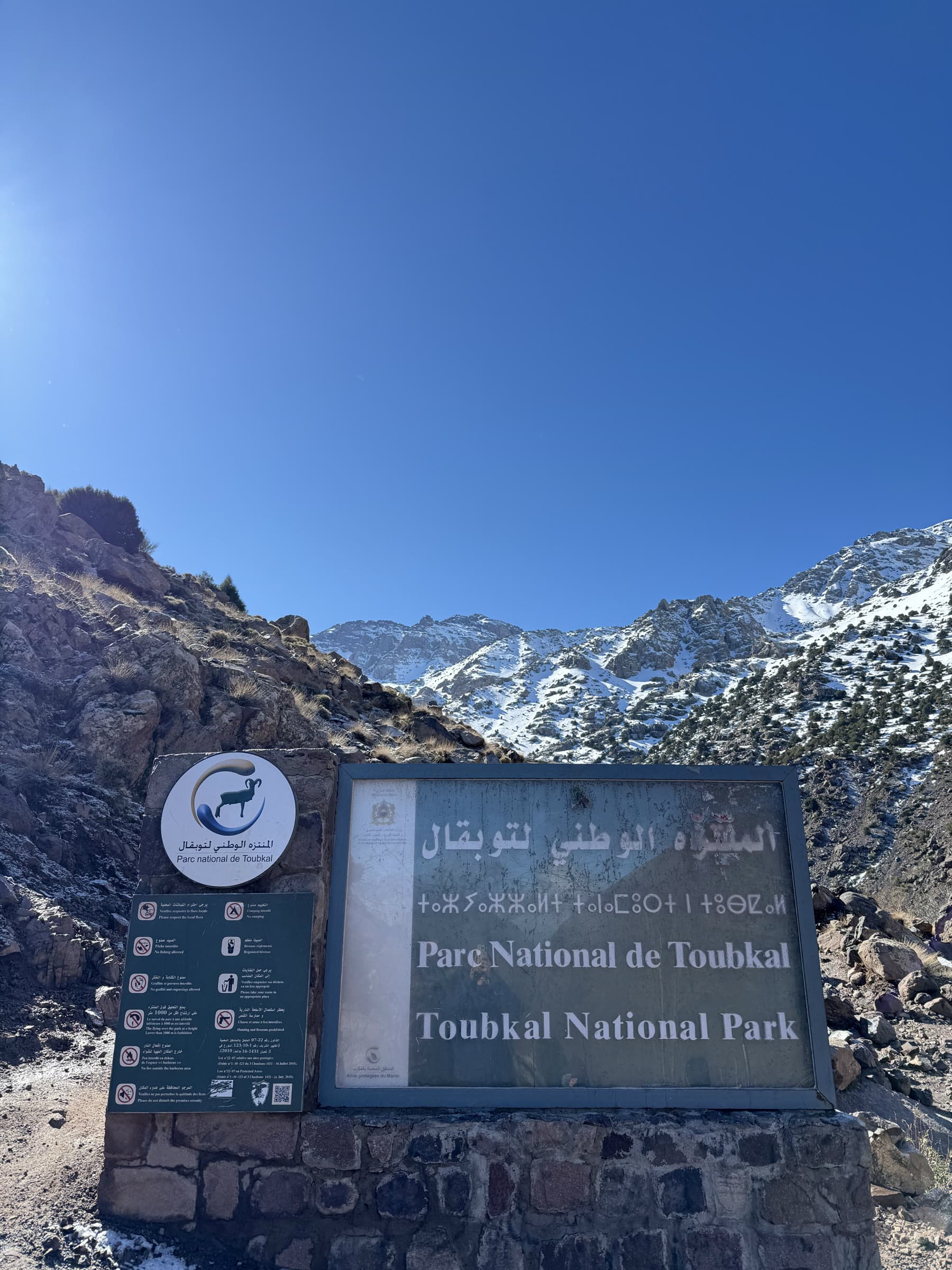
PARK BOUNDARY
THE SHORT ANSWER · YES, IN PRACTICE
Yes. And I want to be careful how I say it, because I am the person selling the guide, so read this knowing that. There are two arguments here and they are not the same size. The first is administrative: above Imlil you walk into the Toubkal National Park, and you should expect to be asked, somewhere on that walk, who you are with. That argument is real, but it is the boring one, and it is the one every blog fixates on. The second is the one I actually care about. Toubkal is not a difficult climb. It is a long, high, weather-exposed walk with one narrow window in it, and my own estimate — an estimate, not a number I can source — is that something like half the people who attempt it do not summit on a first attempt. In my experience that is almost never fitness. It is an unsynchronised group, a pace nobody chose, and a two-day schedule with no margin in it. A guide is not there to find the path — the path is obvious. He is there to make the four or five decisions that determine whether you get up and back down, at the exact hour when you are least equipped to make them yourself.
THE BOUNDARY ABOVE IMLIL
You leave Imlil at 1,740 m, past the last shop that sells batteries and the mule men waiting on loads, and before long you are at the park sign. It is the photograph at the top of this piece — four scripts, Arabic, Tifinagh, French and English, snow ridges behind it. I am not going to quote you a regulation number, and I would be sceptical of any blog that does, because these things are administered locally and the version somebody copied down years ago is not necessarily the version you meet on a Saturday morning. What I will tell you is what I have seen there. Papers get looked at. You are asked who you are walking with and where you are sleeping. If the answer is that you are on your own and you will see how it goes, in my experience that answer creates a problem, and it is not a problem you talk your way out of by being charming or by being visibly fit. The valley is small. The guides know each other and they know who is working and who is not. On our trip you see none of this: Hassan carries the paperwork, the park fees and permits are already inside the EUR 350, and the only thing you notice at the boundary is the sign itself.
IT IS NOT A ROUTE-FINDING PROBLEM
Let me take apart the weakest version of my own argument. The route is 29 km round trip with 2,427 m of ascent and no technical climbing in it anywhere. Friday is a 45-minute walk into Aremd. Saturday is 10 km and 1,307 m up the valley on a track wide enough for mules, past the Sidi Chamharouch shrine, to the refuge at 3,207 m. Sunday goes up the south cwm — boulders and scree — to the ridge, then to 4,167 m, then all of it in reverse. In July, in daylight, with the trail busy, you could follow that on your phone. So here is the honest framing: you are not buying navigation. Fitness for this is a 3 out of 5, and if you can walk six to eight hours on rough ground you can walk it. What you are buying is the answer to a different question — what happens when the thing that goes wrong is not the path. Nine hours moving on Sunday. A 04:30 start by headtorch. 4,167 m, where there is measurably less oxygen and your judgement is the first thing to thin out. And weather that changes on the upper mountain faster than you will believe until it has happened to you once.
WHAT A CERTIFIED GUIDE HERE ACTUALLY IS
The word guide covers two completely different things in Imlil, and telling them apart is the most useful paragraph in this post. Hassan Aït Brahim leads our trips. He was born in the Aït Mizane valley — the valley you walk up — has been guiding since 2012, has more than 200 Toubkal summits behind him, works in four languages, and is certified by the Moroccan national association of mountain guides. That kind of certification comes with a licence number, and I would rather be careful here than sound better than I can prove: ask me for the number before you pay any money, and if what I send you does not check out against the association, do not pay me. Apply that test to anybody selling you this mountain, me included. The other kind of guide is a man with a jacket and a phone number who will take you up for less. Some of them are excellent and have been on that mountain longer than I have. Some have been up twice. You cannot tell which by looking, so ask two questions: show me your licence, and how many times have you been on the summit in the month I am coming. Anyone real answers both without hesitating.
04:30 TO 09:00 · WHAT HE IS ACTUALLY DOING
Summit morning by the hour: 04:30 out of the refuge at 3,207 m by headtorch, 05:45 in the upper cwm at 3,650 m, 06:55 first light on the ridge at 4,000 m, 08:10 on top. Here is what Hassan does inside those four and a half hours that you cannot do for yourself. He sets the pace off the slowest person rather than the fastest, which is why we run one guide to four walkers on summit day — if the group has to split, both halves still have somebody in front. He reads the cwm. That bowl funnels wind and you feel the change in it before you see anything, and the difference between a guide and a strong walker is that he has felt it two hundred times and knows which of those times mattered. He holds the turnaround: 09:00, fixed, no exceptions, and the final word is his, not the group's and not mine. He watches a 50 m visibility floor on the upper ridge. And he carries oxygen and the group first aid kit, which reads like a small line on an inclusions list right up until the person who needs it is you. Our line on altitude is plain: a headache and a bad night's sleep are normal up there, and anything worse means we go down. That is what we do on the mountain rather than medical advice, and I am not a doctor — take your own case to a doctor or a travel clinic before you book.
THE HONEST COUNTER-ARGUMENT
Plenty of fit people have walked up Toubkal alone and been completely fine, and I am not going to pretend otherwise. On a clear Saturday in September, with forty people in the refuge and a well-trodden track underfoot, this is a long walk with a big view at the end of it. If difficulty were the only variable I would tell you to save your money. Two things stop me. The first is that fine most of the time is a poor standard on a mountain where the weather can change inside four minutes. I have watched cloud come over that ridge and take the visibility down to twenty metres in about that long, and that morning is written up in the logbook. Alone at 4,000 m in that, the decision is yours to make using the part of your brain altitude degrades first, and the failure mode is not tiredness — it is a confident bad choice. The second is that on the day it goes properly wrong, the person who comes to get you off that mountain is a local guide. You can pay for one at the start or you can need one at the worst possible hour. Either way, insurance is not optional: we require it and we check it, and it has to cover trekking to 4,200 m and helicopter evacuation.
MY OWN FIRST ATTEMPT
I did not grow up in these mountains. I grew up in Belgium, came to mountaineering as an adult, and my first go at Toubkal was a December ascent I did not finish — I turned back short of the summit in full winter conditions. I went back two months later and stood on the top. The only thing that had changed was preparation: the right kit, a schedule with room in it, a night low down before the push, and somebody with me who had been up there in that month. Not fitness. I was no fitter in February than I had been in December. I mention it because when I tell you to walk with a guide, I am describing the difference between my two attempts rather than a sales position I arrived at afterwards. It is also why our trip starts on a Friday. We sleep at 1,900 m in Aremd on Friday and at 3,207 m in the refuge on Saturday, which puts two nights of acclimatisation under you before the 04:30 start, instead of a two-day dash with nothing spare.
WHAT IT COSTS EITHER WAY
Independently you still pay for the transfer out of Marrakech, two nights of beds, meals, park fees, and any winter kit you do not already own. Guiding arranged on the ground in Imlil may well come to less than a packaged trip, and I am not going to put a number on that, because what I have is prices heard in the valley rather than anything worth quoting at you. If that is the route you want, take it with your eyes open and ask for the licence. Our version is EUR 350 per person for three days, Friday to Sunday: return transport from Marrakech, the certified guide at one to four on summit day, both nights, all breakfasts and dinners plus two trail lunches, crampons and axe in season, poles, a refuge sleeping bag, group first aid and oxygen, and all park fees and permits. Group capped at eight. No single supplement — you are not charged extra for coming alone, and a private room in the valley gîte costs nothing extra if you ask for it and the house has one that weekend. EUR 120 holds a place. If you want Hassan to yourself for the whole trip, that is EUR 480 on top. Insurance is not included and is required. The full breakdown sits on the price sheet, the day-by-day on the Toubkal trip page, and why I run it this way at all is on the about page. Our first departures are October 2026, so I will say the obvious thing: there are no completed trips and no reviews yet, and everything above is my own reasoning plus Hassan's fourteen years, not a testimonial.
PARK FEES AND PERMITS ARE INSIDE THE TRIP PRICE · ASK FOR YOUR GUIDE'S LICENCE NUMBER BEFORE YOU PAY, OURS OR ANYBODY'S · FIRST DEPARTURES OCTOBER 2026