Altitude on Toubkal: what 4,167 metres does to you, and when we go down
Altitude is the one thing on this trip that fitness will not solve for you. Toubkal is 4,167 m — high enough that a good number of people feel it, and not high enough that anyone talks about it properly, so most of what you read is either a shrug or a scare. This is what the thin air actually does, what we do about it, and the point at which we stop climbing and go down. It is the closest thing this site has to a safety page, so I have written it plainly.
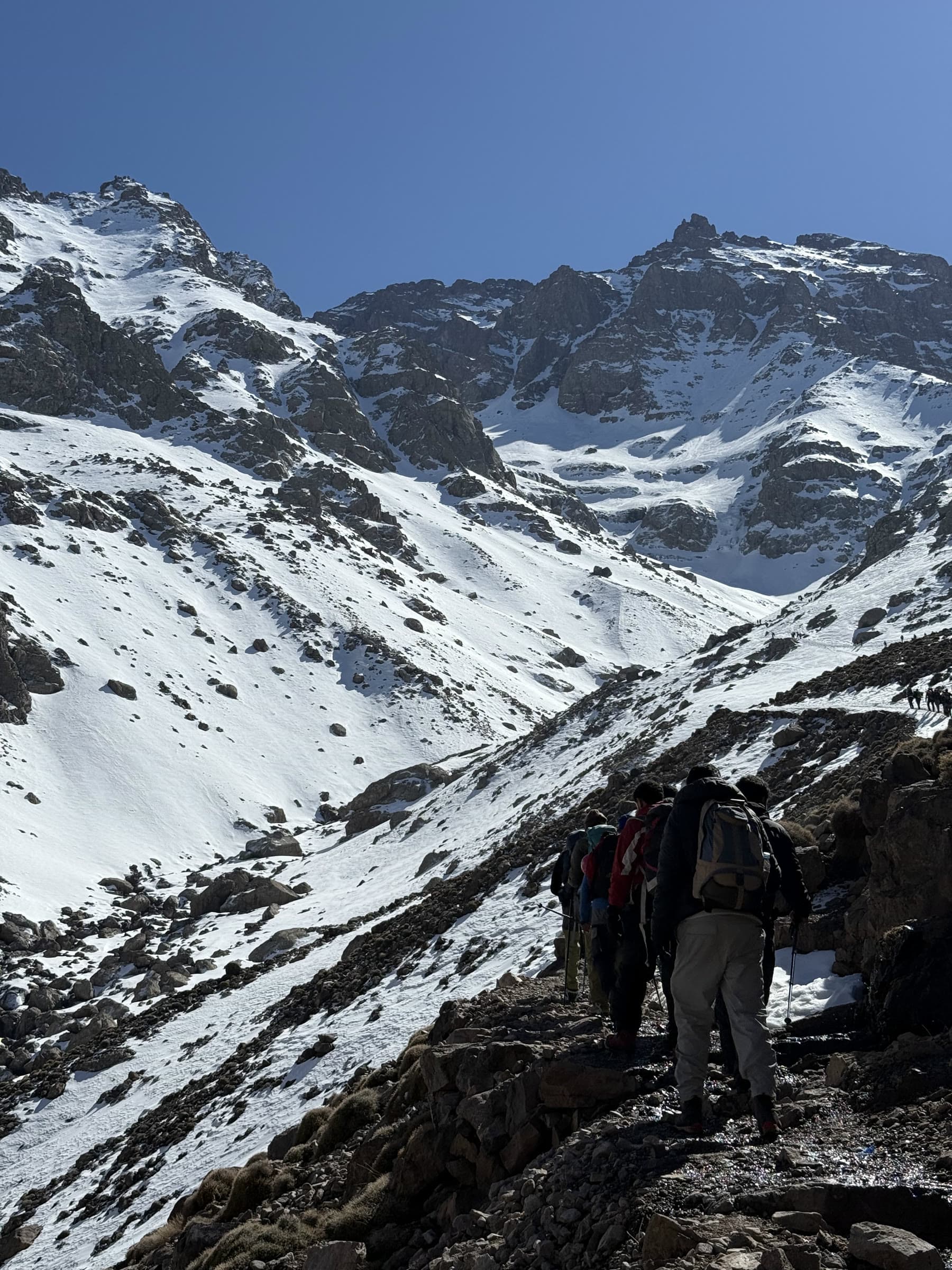
UPPER CWM 3,650 M
WHAT ALTITUDE ACTUALLY IS
The air at 4,167 m is the same air as at sea level — same mix, same proportion of oxygen. What changes is the pressure. There is less of it pushing that air into you, so every breath delivers fewer oxygen molecules than the identical breath in Marrakech at 450 m. At the summit you are working with roughly three fifths of what your body is used to. It notices within hours and starts adapting: you breathe faster and deeper without deciding to, your heart sits higher than normal, and over a couple of days your blood chemistry shifts. The important part is that this process runs on time, not on effort. Marathon runners get altitude sickness. People who have not trained a day in years sometimes sail through. I have watched both happen on the same weekend. Fitness makes the walking easier and makes a nine-hour day less miserable — it does not make you acclimatise faster, and it can work against you if it lets you climb quicker than your body can keep up with. That is the whole reason we walk slowly on purpose, and why the shape of the schedule matters more than the shape you are in.
4,167 M · WHERE THIS ONE SITS
Toubkal is the highest point in North Africa, and in altitude terms it sits in an awkward middle band. It is high enough that ordinary altitude sickness — the headache-and-no-appetite kind — is common. Plenty of people on this route feel some of it, and most of them still summit. It is not so high that the serious forms are the expectation; those are uncommon at this height. Uncommon is not the same as impossible, and I am not going to tell you otherwise. Both of the dangerous versions — fluid building in the lungs, swelling in the brain — are known to happen lower than this mountain, and they are what turns a bad night into an emergency. The other thing worth knowing is that Toubkal is climbed fast. You can be at 450 m on Friday afternoon and 4,167 m on Sunday morning. Nothing about that is unusual here; almost everyone does it in a weekend, because a weekend is the shape of trip most operators sell. But rate of ascent is the biggest single factor anyone actually controls on this mountain, and a two-night weekend is not the same animal as a one-night weekend.
WHAT IS NORMAL UP THERE
Here is what I expect at the refuge on a Saturday night, and what nobody needs to be frightened of. A headache — usually dull, across the front of the head, arriving in the afternoon and easing with water, food and lying down. Sleep that is not really sleep: you drift off, wake at one in the morning certain you have been staring at the ceiling for hours, and lie there listening to the roughly forty other people in the dorm breathe. Breathing that is obviously harder than the effort deserves, on the last hour into the refuge and again on the pull out of the cwm. Less appetite than you would expect after six hours of walking, and a dinner you finish out of discipline rather than hunger. Odd, vivid dreams. Needing the toilet more than usual. None of that means the trip is going wrong. It is what a body does while it is adjusting, and it is the most common conversation at that shared table. Our line has always been the plain one: headache and poor sleep are normal at altitude. Anything worse than that and we go down.
WHAT ENDS THE DAY
And here is the other list — the one Hassan and I are watching for, and the one I want you watching for in the person next to you. A headache that will not lift: it does not answer to water, food or rest, and it is the same or worse after a night. Vomiting that keeps happening, rather than one bout that clears and then you are hungry. Losing coordination — stumbling on ground that does not deserve it, putting a foot wrong again and again, not being able to walk a straight line. Confusion, or someone whose personality has gone strange: not answering properly, or oddly stubborn about carrying on. Breathlessness while sitting still, as opposed to while climbing. A cough that will not settle, or breathing that sounds wet. Someone who cannot hold a pace they were comfortable with two hours earlier. In plain terms: if it is the head, the balance, or the breathing at rest, the day is over. We do not debate it, we do not wait to see how you feel at the next stop, and nobody has to prove anything. The person who says something early is the one who makes it easy for the whole group.
THE ONLY TREATMENT IS HEIGHT YOU GIVE BACK
There is one rule and it is not complicated: the treatment for altitude is going down. Not resting for an hour. Not more water. Not pushing on to the summit and dealing with it in Imlil. Losing height. It works quickly and it works reliably, and it is the reason a mountain like this one is manageable at all. Everything else — oxygen from a bottle, warmth, hot sweet tea, a night lying still — buys time or makes the descent possible. Descent is the thing that fixes it. Which brings me to the part I care about most, because it is the part that stops people speaking up. On our trips, going down is not a punishment and it is not a failed trip. Turn back at 3,900 m and you have still climbed nearly 700 m above the refuge. If the guide turns the whole group around, you get a free date change and you pay only for the refuge night. If it is one person who needs to lose height, that is part of why the ratio on summit day is one guide to four walkers: one person descending does not end the day for the other seven, and nobody goes down on their own.
1,900 M, THEN 3,207 M · THE MARGIN
The acclimatisation on this trip is not a technique. It is the itinerary. Friday afternoon we leave Marrakech at 450 m, walk 45 minutes up to Aremd at 1,900 m, and sleep there. That night is doing real work: your body starts adjusting a full day before it is asked to climb anything. Saturday is 10 km and +1,307 m to the Refuge des Mouflons at 3,207 m, about six hours, and we arrive in the afternoon rather than at dusk — which means time to rest, an early dinner, and asleep by nine at a height where sleeping is the adaptation. Sunday you climb 960 m from a body that has had two nights of warning. Set that against the two-day version, which is the standard weekend on this mountain: Marrakech to the refuge in one push, summit the next morning. Same summit, one fewer night, and the night it removes is the low one that does most of the quiet work. It also removes your margin. If somebody is struggling on a two-day schedule, there is nowhere in the plan to put them. That is what the extra night buys. It is why we start on a Friday.
WHAT WE ACTUALLY DO ON THE MOUNTAIN
Slowly, on purpose. The pace on Saturday will feel too slow for the first hour and about right by the fourth. If you are the slowest in the group, the group walks at your pace, or we split with the second guide — that is what one-to-four on summit day is for. Hassan carries oxygen and the group first aid kit; he was born in this valley, has been guiding since 2012, and has more than 200 Toubkal summits behind him. He decides turnarounds, not me and not the group. Saturday evening at the refuge there is the oxygen check, which is less dramatic than the name: as we intend to run it, it is a short set of questions rather than a recorded saturation reading. He takes people one at a time — head, appetite, how much you actually drank, whether you are breathing hard sitting still — and the point of it is to catch the things people sit on out of politeness. Sunday there is a fixed turnaround at 09:00, no exceptions. And one practical mercy of this route: from anywhere on it, going down is walking. There is no point where you need a rope or a climbing move to get off the hill. In winter, above the refuge, it is snow and you come down on crampons — which is why they are taught at the refuge the evening before — but it is still walking.
INSURANCE, AND GETTING OFF THE HILL
Insurance is required on this trip and we check it. Not as paperwork theatre — because the useful version of a bad day involves a helicopter and somebody else's money. It has to cover trekking to 4,200 m and helicopter evacuation. Most European policies with a mountain add-on qualify, as do World Nomads and Alpine Club cover. A standard travel policy with no altitude clause usually does not, and neither does the free cover attached to a bank card. Read the altitude limit in your own document, and look for what it says about trekking and mountaineering, before you pay for it. If you cannot find the limit, ring them and ask; if the answer is vague, that is an answer. The other half of getting off the hill is the walking part, and that is what the guide's judgement is for. It is also why I would much rather you said something at the refuge than at 4,000 m on the ridge. A descent that starts at 3,207 m in daylight is a different proposition from one that starts high, in the dark, with somebody who cannot walk straight.
WATER, ALCOHOL, SLEEP — AND WHO TO ASK
Water: you lose more than you think up there, because the air is dry and you are breathing hard, and dehydration produces a headache that looks exactly like altitude. Drink more than you feel like, and be honest with yourself about how much that actually was. Alcohol: we do not carry any on the trip, and I would leave it alone in Aremd on the Friday too. It works against your sleep, against your hydration, and it muddies the one signal that matters — whether the way you feel is the mountain or last night. Sleep will be poor at 3,207 m and that is expected; lying still in the dark is worth more than you would think. Before you come, talk to a doctor or a travel clinic properly, not a search engine. That goes double if you have a heart or lung condition, if you are pregnant, if you take regular medication, or if you have had altitude illness before — which is the thing most likely to mean it happens to you again. This post is what we do on the mountain. It is not medical advice, and I am not a doctor. If you want to talk through the schedule, or whether this route suits you, the trip is at the Toubkal trip page, the insurance wording and the kit we expect are set out on the practical briefing, and I answer my own messages, usually within four hours.
WHAT WE DO ON THE MOUNTAIN, NOT MEDICAL ADVICE · SEE A DOCTOR OR TRAVEL CLINIC BEFORE YOU TRAVEL · INSURANCE TO 4,200 M IS REQUIRED AND CHECKED · FIRST DEPARTURES OCTOBER 2026